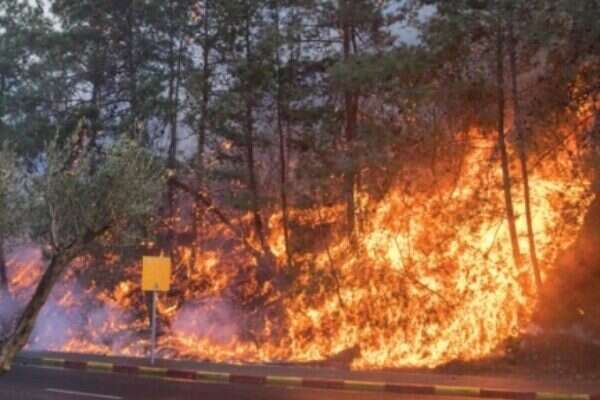
This week, Israel fought another version of the 1967 Six-Day War -- this time against fires that raged through much of northern Israel, Judea and Samaria and the Jerusalem region. There were 1,773 brush fires and 80,000 Israelis had to be evacuated from their homes, many of which were consumed by fire, leaving nothing. Some people have been screaming themselves hoarse for years, warning that this was going to happen. Last June, the Knesset Research and Information Center published a report about severe agricultural crime in Israel. A number of players were behind the report. Hashomer Hahadash, a civilian volunteer group that works to contain agricultural crime through guarding and educational activity, was one of the main ones. The report devoted only a page and a half of its 46 pages to terror by arson, and that page and a half went unnoticed by almost all of us. One of the astonishing revelations of the report was that in 2014, there were 28,543 wildfires in Israel, 65% of all the fires nationwide for that year. But only three investigations into suspected arson were launched. Despite a conservative assessment that one-tenth of wildfires, exactly the type that last week spread to populated areas, are the result of deliberate arson rather than carelessness or weather conditions, it would still amount to an incomprehensible number. A look at the data from the Israel Fire and Rescue Service for the past four years shows that 2014 was not an outlier. From 2012 to 2015, 123,326 wildfires were documented (64.75% of all fires in that time period) but only 35 cases were opened because of suspected arson, an average of eight to nine per year. Everyone thinks that the number of fires that resulted from arson is many times higher. What's more, even this week, when the picture changed dramatically -- both in terms of the number of fires and arson cases and the number of investigations opened and suspects arrested -- only a negligible number of fires are investigated. Head arson investigator for the Israel Fire and Rescue Services Ladderman Ran Shelef told the members of the Knesset Research and Information Center in June that only a few wildfires were investigated each year, and that most of the some 5,000 investigations into the cause of fires focused on building and vehicle fires. Even last weekend, when the latest round of fires was at its peak, when Shelef provided an interim summation of the 1,300 wildfires of that same week, only 30 had been investigated, about 2%. This week, too, the over 100 fires already under investigation accounted for only 8% of the fire cases. Shalaf was honest enough to admit that "we cannot investigate 1,300 fires a week." Still, he thinks that 60-70% of the few fires that were investigated were the result of arson. A misfortune? The numbers collected by Hashomer Hahadash show how widespread the phenomenon of arson really is and the extent to which it has thus far been ignored. The most notable incidents that the group recorded took place over a number of years at Kibbutz Hamadia in the Beit Shean Valley, which saw repeated fires caused by arson from 2002 to 2005, 2009 to 2011, 2012 to 2013, and six fires in 2015 alone. No one was ever caught. The security establishment believes that most of the cases were attempts by Arabs to push Jews off grazing territory that was declared state lands and take it for themselves. But Hamadia isn't the only place where it happened. Fires in the northern Israel communities of Moshav Givat Nili, Karei Deshe, Kochav Hayarden (Belvoir) National Park and Moshav Bethlehem of Galilee, as well as Moshav Zippori, Moshav Moledet, Kibbutz Beit Hashita, Kibbutz Ein Harod, the city of Metulla and Yavne'el are believed, if not proven, to be arson, generally from the same motives as the Kibbutz Hamadia fires. Yehuda Marmor, a farmer from Yavne'el who owns grazing land in the Yavne'el Valley and the Jordan Valley, has been the victim of dozens of arson fires in the past 10 years, which cause damage estimated at hundreds of thousands of shekels every year. "Every time it happens, the feeling is almost like a heart attack. In the summer it burns, and in winter it grows again, but for that year, I don't have food for the cattle, and there's still damage to the rest of the plant life and to the animals, and there were fires that endangered the houses around here," Marmor says, adding that the police generally reach him after the incident, write a report, and take a complaint. "A month goes by, the case is closed due to lack of evidence or lack of public interest," Marmor says. According to figures from the Public Security Ministry, some 37,000 dunams (about 9,100 acres) of open land are lost to fires each year. Some 75% of the fires take place between May and September. The ministry believes that a large part of the fires are the result of hostile arson. But until this week, the authorities treated deliberately-set brush fires as a type of misfortune. There is even no orderly documentation of fires like these. Thousands of cases of fires on farmland, in forests, and in open territory, which this week spread to populated areas, were until now classed as "agricultural crime," a category that also includes theft of livestock and property. Uri Sapir, a battalion commander in the IDF reserves and Northern Regional Manager for Hashomer Hahadash, says that the people who neglected the problem of wildfire arson -- which destroyed property, fields, crops and nature -- are now getting life-threatening fires close to population centers. Sapir is careful not to blame the Israel Police or the Border Police: "I know that resources are limited, and I can even understand the priorities of the security establishment. It really is more important to capture a Hamas cell that's planning a shooting attack or send forces to Jerusalem to prevent civilians from being stabbed, but you have to understand -- this yearslong neglect [of arson] comes at a price. It means a tough loss of sovereignty over open areas." A single match is enough This week, as homes stood burned to the ground and tens of thousands of people fled for their lives from the fires, the penny finally dropped. Last week, about 100 fires were investigated, and interim results indicate that only about one-quarter of them (according to the Israel Fire and Rescue Services) appeared to be caused by arson. Of these, there is supposedly proof of arson of only 13 cases in Judea and Samaria and a few but important cases inside the Green Line. Other fires that caused major property damaged are still under investigation. The police and fire department are playing it close to the chest for now, even though the suspicions are obvious. Nevertheless, the Israel Tax Authority, to the dismay of the aforementioned bodies, rushed to officially declare a series of fires "terrorist attacks." The police are saying the announcement was made too hastily, that it would take some time before the suspicions could be proved. But in the meantime, the Treasury and the tax people have officially recognized the following fires as the result of terrorist arson: Moshav Tal-El last Sunday; Zichron Yaakov last Tuesday, where materials used to set the fire were found; Dolev Tuesday night; Gilon and Talmon last Wednesday night; and at least one source of the fire in Haifa early last Thursday morning. Students at the Or Vishua National Torah Center in the Neve Shaanan neighborhood in Haifa caught an Arab youth red-handed as he was trying to set fire to some nearby brush growth using cardboard. The fires in Nirit on Thursday, in Nataf last Friday, and Neve Tzuf-Halamish last Saturday have been recognized as acts of terrorism. Three Molotov cocktails and the remains of another Molotov cocktail found near Halamish showed investigators that this was no spontaneous conflagration. Similar evidence was found in the area around Dolev. In the area around the village of Dir Kadis near Ramallah, IDF forces caught three suspects in a car in which they found lighters, gloves and full bottles of fuel. Arsonists from nearby villages were also spotted around the settlement of Yizhar, where fields and land near Jewish homes were set ablaze. A suspect was arrested in Begin Park in Jerusalem after he was seen setting a brush fire in the area. Two young people from Sajur near the Druze town of Beit Jann in the Galilee were arrested in similar circumstances, as were three suspects from the northern Bedouin village of Basmat Taboun, who are believed to have set fire to a nearby forest. Providing legally viable proof of malicious arson west of the Green Line is no easy task. Unlike Judea and Samaria and east Jerusalem, where most of the fires are the result of open hostile actions (mainly throwing Molotov cocktails -- about 5,500 in the past four years) many fires in Israel proper, even if set maliciously, are set using a single match, burning cigarette butt, or lighting a piece of cardboard. In extreme weather conditions, like what prevailed last week, this is enough. The wind and the low humidity do the rest. It's hard to crack cases like these. For fires to be classed as terrorist attacks, there needs to be proof that they weren't the result of an accident, as the suspects automatically claim, but rather malicious intent. Only a few cases turn up piles of tires and kindling that were collected ahead of time, but even then these stockpiles must be linked to specific suspects and malice proved. As the investigation of the recent fires progresses, the police and the Shin Bet security agency are becoming convinced that the damage caused by the fires on Monday and Tuesday of last week set off a wave of imitation ethno-religious arson attacks. The process is similar to what took place in the wave of stabbing attacks, many of which were "imitators." As of now, the arson activity does not appear to have been coordinated or organized. As of Wednesday, 29 of the suspects arrested -- 15 Israeli Arabs and 14 Palestinians from Judea and Samaria -- were still in jail. The suspicion that Israeli Arabs might have been involved is already causing vigorous debates. This suspicion presses on the raw nerve of relations between Israelis Jews and Arabs, and stems not only from the high number of Israeli Arabs among the individuals suspected of setting the fires, but also from broader data. Israel Police Commissioner Insp. Gen. Roni Alsheikh told the Knesset last February that 58% of arson fires in Israel are set by Arabs. Border Police figures on the ethnic breakdown of perpetrators of agricultural crime for 2012 to 2015 provide a similar picture: 1,269 Israeli Arabs, 355 Palestinians and 399 Jews. In the vast majority of cases, no one was indicted or tried for the crimes for the following reasons: the criminal was not identified; lack of evidence; lack of public interest. Will Arab society take a look at itself- As we might have expected, Arab-Israeli, Palestinian and Middle East social media jumped into the minefield as the fires raged. But this time, there's more than one side. Just like the stabbing intifada, there are plenty who are fanning the flames, inciting and dancing as the buildings burn. But there are also many others who are posting or tweeting reservations about or harsh condemnations of the fires and arson. There were plenty of voices among Israeli Arabs, even the southern faction of the Islamic Movement, who urged people to open their homes to Arabs and Jews whose homes had burned down. Harsher condemnations, which came despite bad blood, were posted by Arab MKs. They condemned the fires but stressed that they were fires in "their homeland," and also protested against the "automatic suspicion of and stigmatization of an entire sector." Unusually, the Palestinian Authority also joined in condemning the fires, and even sent teams of firefighters and fire trucks to help put them out. Still, other voices in the PA encouraged the arsonists and celebrated at the sight of the flames. Reactions in Arab nations were also mixed. Official condemnations and active firefighting assistance from Jordan and Egypt (both countries sent firefighting aircraft) came alongside an outpouring of hostility and joy at the sight of the fires. The most passionate response to the fires among Israeli Arabs came from chairman of the Joint Arab List Ayman Odeh, who made it clear in an interview that the fires were an attack on everyone in the country: "The Carmel is no less mine than anyone else's. ... These are my trees. ... This is my place, I'm the one hurt here, not you! ... This is my forest. These are my trees. I was born here. My father was born here. My grandfather was born here. ... This is our homeland." Odeh's party colleague MK Ahmad Tibi stressed that if it turned out that most of the fires were arson committed by Arabs, it would be a terrible thing that would demand condemnation and that the Arab society take a look at itself. He refused, however, to use the terms "terrorism" or "intifada" to describe the fires or the arson cases. One post on Arab social media perhaps sums up the motives of at least some of the people who condemned the arson: "The trees, the mountains, the open spaces, in other words, the homeland, are burning. ... Have we become so weak that we get excited at the sight of a burning tree? ... If only we overcome our ignorance one day."
Others agreed that "they" would one day return, so why burn it down-
Sounding the alarm
The increasingly common arson brush fires in Israel have been dismissed as misfortune, and only a handful have been investigated • A volunteer group devoted to containing agricultural crime says that lax policy led to the awful fires of this past week.
Load more...