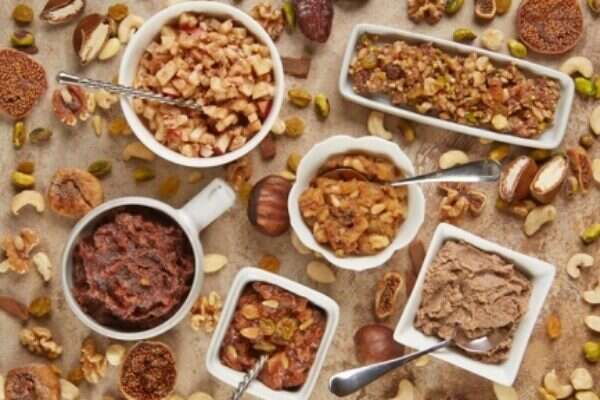
Of all the holidays in the Jewish calendar, Passover serves as the cornerstone. Family and friends come together at home for a meal disguised as a religious service. It is the time for the annual retelling of the story of the Jewish exodus from Egypt. The Haggadah, the ancient book that tells the story of Passover, was artfully written as a history with an emphasis on passing on the traditions and the faith of the holiday from one generation to another through rituals and endless glasses of wine. No fools, those early rabbis. They understood that the best way to make sure the symbols endured was to make them edible. Boston venture capitalist Andy Goldfarb is a passionate believer in the magic of Passover and an ardent cook. Goldfarb grew up celebrating Passover with his great-grandfather, Max Fish, in Baltimore. The Passover tradition goes back far in Goldfarb's family: He recently found a family photo of his great-great-grandfather holding a Passover Seder in 1930 in Dynow, Poland. Passover is a year-round project for the Goldfarb family, beginning with the etrog (citron) marmalade his daughter Jemma makes during Sukkot in the fall and continuing up to the Seder night in spring. Goldfarb became convinced he could help other Jewish families make Passover as "magical and memorable" for their families as it is for his. He developed the website Breaking Matzo as a kind of resource guide for the Jewish community. He believes that by making the holiday meaningful and fun for all generations, it increases the likelihood of families continuing the Passover tradition generations into the future. Haroset: A traditional symbol on the Seder plate At the center of any Passover table is the Seder plate, a platter of specific edible symbols: a roasted lamb shank bone; a roasted or hard-boiled egg; a fresh green herb such as parsley; a bitter herb such as horseradish; a bowl of salt water for dipping the herbs in symbolic tears of the slaves. The final element is haroset, typically a sweet concoction of dried fruits, chopped nuts and wine. Haroset is the only element that requires a recipe, and each family has its own. During the Seder, haroset is eaten on a piece of matzah, and its gritty texture represents the mortar, or cement, the Israelites used to make the bricks for Pharaoh's pyramids. Goldfarb has been lucky enough to celebrate Passover with Jewish families around the world. He has been able to learn how each community of Jews, no matter where history and fortune has taken them, adapts Passover by creating a local version of haroset for the Seder table. If there is anything that speaks to the resilience of the Jewish people, it may be these recipes for haroset, also available on the Breaking Matzo site. Ashkenazi haroset Most American Jews are of Ashkenazi descent, whose ancestors spent centuries in Europe. The Ashkenazi preparation of haroset, considered the "typical" or classic recipe, uses ingredients that were available in eastern European kitchens. Ingredients 2 medium-sized tart apples 1/2 cup walnuts, chopped 1 teaspoon cinnamon 1 tablespoon sugar or honey or to taste 2 teaspoons sweet red kosher wine Directions Peel, core and finely chop or grate the apples. Mix with the rest of the ingredients in a bowl. Makes about 4 cups. Chinese haroset For several years, Goldfarb lived and worked in Japan. He also traveled in China and studied the Fugo plan, a Japanese program to save Jews from the Nazis by settling them in Shanghai during World War II. Goldfarb found a connection with the wandering Jews of China, who still celebrate the Passover story with this savory haroset, which contrasts with most other haroset recipes, which are sweet. Common ingredients in Chinese cuisine that are highlighted in this version of haroset are soy sauce, pine nuts and honey. Ingredients 1/2 pound of dates, finely chopped 4 apples, finely chopped 1/2 cup pine nuts 3 tablespoons soy sauce 4 tablespoons honey Juice of one orange Directions Heat ingredients in a saucepan until soft and smooth, about five minutes. Serve chilled or at room temperature. Makes about 6 cups. Moroccan haroset Goldfarb learned that the Egyptian Jewish tradition is that the paste of the haroset represents the color of the Nile silt used to make the mortar for the bricks to build the pyramids. A mixture of dates and raisins approximates the color. He became fascinated with other Middle Eastern and North African haroset variations, which use all kinds of dried fruit and even bananas. In Algeria, he found a blend of dates and dried figs with cinnamon, nutmeg and sweet red wine. In Iraq, date syrup is mixed with plenty of chopped walnuts. A recipe from Surinam includes dried apples, pears, apricots, prunes, raisins, grated coconut, ground almonds, walnuts and cherry jam. The following are adaptations of traditional Sephardi classics. Proportions vary from one family to another, and the texture can be coarse or smooth, thick or thin. Ingredients 1 pound dates, pitted and chopped (about 3 cups) 1 1/2 cups sweet red kosher wine 1 teaspoon ground cinnamon 1/2 teaspoon ground cloves 1 cup walnuts, coarsely chopped Directions Put the dates in a pan with the wine, cinnamon and cloves and simmer, stirring occasionally, until it is a soft paste (about 5 minutes). Pulse in a food processor for a smoother texture. Let cool and stir in the walnuts. Makes about 3 cups. Variation: A Libyan version is flavored with ground ginger, nutmeg and cloves, 1/4 teaspoon of each spice. Piedmontese haroset The Jews of Italy's Piedmont region live surrounded on three sides by the Alps, where nut trees dot the scenery. This recipe makes use of the local harvest of chestnuts and almonds and counters the nuts' richness with the powdery smoothness of egg yolks and a sharp hit of citrus. Ingredients 1 1/2 cup cooked chestnuts 2/3 cup blanched almonds 2 hard-boiled egg yolks Zest of 1 orange Juice of 1 orange 1/3 cup sugar 3/4 cup sweet red kosher wine Directions Finely grind the almonds in a food processor. Add the rest of the ingredients and blend to a smooth paste. Makes about 2 1/2 cups. Italian haroset Unsurprisingly, every region of Italy has its own version of haroset. The haroset of Padua has prunes, raisins, dates, walnuts, apples and chestnuts. In Milan, they make it with apples, pears, dates, almonds, bananas and orange juice. This recipe is a basic one, but every Italian Jewish home has its own "classic" recipe. Ingredients 3 apples, sweet or tart 2 pears 3/4 cup yellow raisins or sultanas 1 cup prunes, pitted and finely chopped 1 1/3 cups dates, pitted and chopped 2 cups sweet red kosher wine 1/3 cup pine nuts 2/3 cup almonds, finely chopped 1/2 cup sugar or honey 1 teaspoon cinnamon 1/2 teaspoon ground ginger Directions Peel and core the apples and pear, cut into small pieces. Put all the ingredients into a pan together and cook, stirring occasionally, for 20 to 30 minutes, until the fruits are very soft, adding a little water if it becomes too dry. Makes about 7 cups. Variations: Other possible additions include chopped lemon or candied orange peel, walnuts, pistachios, dried figs, orange or lemon juice, ginger, nutmeg and cloves. Spanish haroset For hundreds of years, southern Spain was the site of a great Jewish renaissance, where Jews and Muslims lived peacefully together, fostering a cultural flowering that earned the region the title "Ornament of the World." Ultimately, the Jews were forced from Spain, but the splendor of the enduring Sephardi tradition lives on in this haroset recipe. Ingredients 2 apples 2 pears 1/2 cup Spanish almonds (blanched Marcona if possible) 1/2 cup hazelnuts 1/2 cup walnuts 1/2 cup pistachios 1/2 cup chopped dates 1/2 cup chopped figs 1/2 cup yellow raisins 1/2 cup dry red wine, divided 1/2 teaspoon ground ginger 1 teaspoon cinnamon Directions Peel, core and finely chop the apples and pears and place in a large bowl. In a food processor, pulse all the nuts, making sure not to over-grind. Add the chopped dates, figs, and raisins and 1/4 cup wine to the food processor bowl. Pulse again briefly, or mix by hand. Add the mixture to the bowl of grated fruit and stir to combine. Blend in the ginger and cinnamon and add as much of the remaining wine as will make a smooth paste. Makes about 4 cups. Copyright 2016 Louisa Kasdon via Zester Daily and Reuters Media Express.
6 haroset recipes honor a world of traditions
Venture capitalist and ardent cook Andrew Goldfarb believes that meaningful, tasty Passover celebrations help families preserve tradition • Haroset, the dip that symbolizes mortar, is made with a variety of recipes by Jewish communities around the world.
Load more...