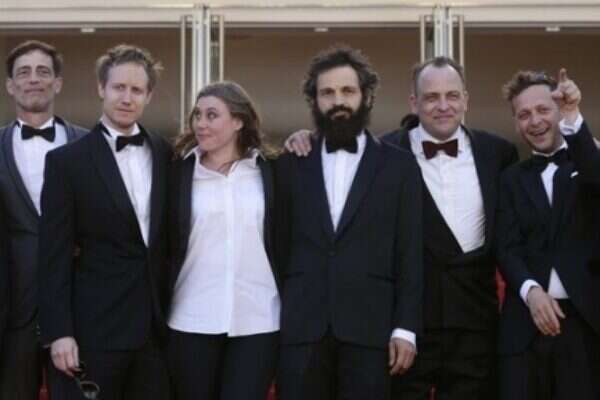
A Hungarian film that takes viewers into the hellish heart of the Holocaust has left Cannes reeling. "Son of Saul," the first feature from director Laszlo Nemes, has become an early favorite to win the Palme d'Or and has been praised for re-imagining the way the Holocaust is depicted onscreen. The Hollywood Reporter called the film "remarkable -- and remarkably intense," while Variety judged it "terrifyingly accomplished." The Guardian's Peter Bradshaw said it was "devastating and terrifying" and praised its "gaunt, fierce kind of courage." It's rare for a director's first film to be chosen for Cannes' main competition, rarer still for it to be met with such an enthusiastic response. Cinematographer Matyas Erdely said Friday the challenge for the filmmakers was "how to show things that are not possible to show." "The genius idea of Lazlo's was that we just won't show things that cannot be shown," he told reporters. "Basically our approach was to exclude everything that is not fundamental to our story." "Son of Saul" focuses on an Auschwitz death camp Sonderkommando, one of the Jewish prisoners forced to help dispose of the corpses of those killed in the gas chambers. The Sonderkommandos were given better food and living conditions than other inmates but were inevitably executed after a few months to prevent them from revealing the secrets they knew. Nemes, who has worked as an assistant to Hungarian auteur Bela Tarr, focuses his film almost exclusively on Saul (Geza Rohrig), a character who undertakes a single-minded plan to offer one dead boy a proper burial. The horrors of the concentration camp are not hidden but they unfold in the background, or off to the side of the screen. "We thought that less was more," the 38-year-old Nemes said, explaining his decision to let viewers' imaginations fill in the gaps, aided by an unforgettably evocative soundtrack. "What was important for me was to make a film about this hellish experience in a different way. ... We wanted to boil everything down to the dimension of a single human being." "Son of Saul" offers neither hope nor redemption, and many viewers found watching it a draining experience. Rohrig, a New York-based Hungarian poet who fills almost every frame of the movie, said his biggest challenge was to play a character whose horizons and emotions have withered under brutal conditions. "The only way to remain sane and live this type of life was to cease to be a human being, to be detached from your emotions," Rohrig said. "The challenge of the character was to dance in a very, very small area, in a very minimalist way." Also at Cannes, American-Israeli actress Natalie Portman made her directorial debut. Portman's first feature, "A Tale of Love and Darkness," is a Hebrew-language film adapted from an autobiographical novel by Amos Oz. The film is an ambitious period piece that charts the birth of the State of Israel and a boy's initiation into the realities of disappointment and death. Portman also wrote the screenplay and stars as the boy's mother, Fania, a cultured and imaginative woman whose dreams cannot withstand grinding everyday reality. Portman's film is playing as a special screening outside of the main competition at Cannes, just as Ryan Gosling's film "Lost River" did last year. "A Tale of Love and Darkness" did not draw as strong a response from critics as "Lost River," a baroque urban fairy tale generally panned as an ambitious flop. Portman's film, a reverent adaptation with a vivid sense of place but less memorable characters, received mild applause at its press screening Friday. It has its gala festival screening on Saturday. Robbie Collin of Britain's Daily Telegraph tweeted that the film was earnest but "completely respectable," while Variety's Peter Debruge said the "drearily empathetic film lacks whatever universality has made [the book] such an international phenomenon."
Holocaust drama 'Son of Saul' leaves Cannes audiences shaken
First feature from Hungarian director Laszlo Nemes tells the story of Jewish concentration camp inmates forced to dispose of corpses • Film called "terrifyingly accomplished" • Natalie Portman's directorial debut gets lukewarm reaction.
Load more...