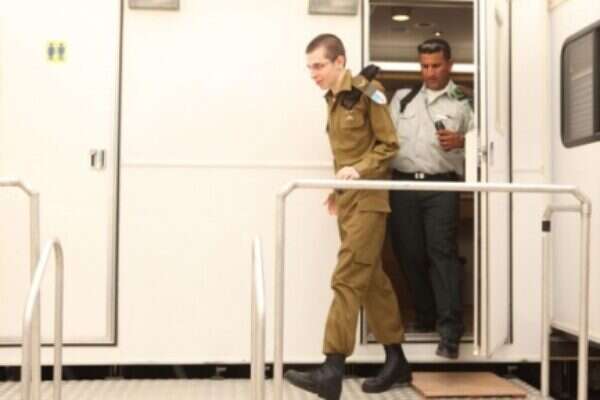
The words that Israelis have been waiting to hear since that fateful day in June 2006 when Israeli soldier Gilad Shalit was abducted by Hamas in a cross-border raid were finally spoken by Israel Defense Forces Spokesperson Yoav Mordechai Tuesday morning near the Kerem Shalom border crossing. "Gilad Shalit has returned home after five years and four months in captivity. He is with us today," Mordechai said during a speech at around 11 a.m. A struggle spanning 1,941 days of nightmares, fears, and terror as well as insurmountable longing by his family and the nation for his return came to a dramatic end on Tuesday as Shalit set foot on Israeli soil again. Shalit, now aged 25, did not have a single visit, either from his family or from the Red Cross, during his time as a hostage in Gaza. He was 19 years old when he was abducted. Upon his return to Israel and his arrival at the Tel Nof Air Force base, Shalit was greeted by Prime Minister Benjamin Netanyahu who hugged him and told him, "Shalom, Gilad. Welcome back to Israel. It's so good to have you home," and then escorted him to his family. In an emotional and long-awaited reunification, Shalit met his family for the first time since he was abducted. Netanyahu said to Shalit's parents, Noam and Aviva, "I have brought your son home." In a speech to the public following the Shalit family reunification, Netanyahu said, "Two years ago, I returned to the post of prime minister. One of the main and most complicated missions I found on my desk was to return Gilad Shalit home alive and well. Today that mission was accomplished." "It entailed an extremely difficult decision," Netanyahu said. "I faced the need to return home someone who was sent by the state of Israel to the battlefield. As a soldier and commander, I was dispatched many times by the IDF for special operations, but with the belief that if I, or my friends, would be taken hostage, the government of Israel would do everything in its power to bring us home. "And this is what I have carried out as prime minister of Israel. As a leader that sends IDF soldiers out every day to defend the country, I believe that mutual responsibility is not just a slogan, but one of the cornerstones of our existence." Netanyahu also said that he faced the additional task of minimizing the risk for Israeli citizens, and therefore decided to keep Hamas top brass imprisoned and insisted that the majority of prisoners released be exiled. Netanyahu warned that any prisoners released who returned to terrorist activity "were taking their lives into their own hands." Speaking on the pain felt by bereaved families in light of the release of prisoners, the prime minister said, "I am well aware of the pain felt by the families of terror victims. It's difficult to see the evildoers who murdered their loved ones being released." "I thought of Gilad, of the five years in which he rotted in Hamas captivity. I did not want his fate to be that of [missing IAF navigator] Ron Arad, who was taken captive 25 years ago, and has not returned home since," Netanyahu said.
Netanyahu concluded his speech by saying, "The sons have returned to their borders. Am Yisrael Chai [the people of Israel live]."
Defense Minister Ehud Barak, who also greeted Shalit when he landed at the Tel Nof base, said, "As Gilad's commanders, we the government had to pursue all reasonable and responsible options to have him return safely. But not at all costs. And we did that. Today we also remember his fellow tank comrades that were killed in the raid in which he was captured. I wish Shalit and his family a return to normalcy."
Shortly before he was transferred by Egypt to Israel as part of a prisoner exchange deal, Shalit was heard speaking for the first time in over two years in an interview with Egyptian television broadcast on Israeli TV.
"I'm very emotional. I missed my family," a thin, pale, and seemingly dazed Shalit said during the interview. "I missed friends, seeing people, I missed going outside and not sitting all day, to do the same things."
Before learning he would be released, Shalit said he feared he would remain in captivity "many more years" and worried since being told of the deal last week that last-minute hitches might lead to its collapse.
Asked whether he would campaign to help free the remaining 4,000 Palestinians imprisoned in Israel, he said "I would be happy to see them free, as long as they don't come back to fight against Israel."
"I hope this deal will promote peace between Israel and the Palestinians," he added.
After Shalit was transferred to Israel, IDF Spokesperson Mordechai confirmed in a second address to the public that Shalit was in good health, and that after reuniting with his family at the Tel Nof Air Force base and undergoing final checks, the Shalit family would return to their home.
Shalit was released as part of a prisoner exchange deal agreed upon last week by Hamas and Israel after countless rounds of negotiations between the two sides in previous years. The deal saw the release of Shalit in exchange for 1,027 Palestinian prisoners. When Tuesday's exchange is complete, 477 Palestinians held in Israeli jails will have been released, several of them after decades behind bars. Another 550 are set to be released in two months.
Tuesday's long-awaited prisoner swap - dubbed operation "Beit Hashoeva," in reference to the commemoration of a Temple-time mass celebration of drawing water from a specific spring and taking it to the Temple during the festival of Sukkot - began at around 6:30 Tuesday morning when Aviva and Noam Shalit, together with their children Yoel and Hadas, as well as Gilad's grandfather, Zvi, departed from their home in Mitzpe Hila on a helicopter heading to the Tel Nof base. When the family returns to their home Tuesday evening, Gilad will be by their side.
At around 7:30 a.m., the first Palestinian prisoners held in Israeli jails to be released, the 27 female prisoners, were transported to locations near the Egyptian border and the West Bank from where they were to be released. About three hours later the IDF confirmed that Shalit was transferred to Egyptian representatives after he was identified at the Rafah border.
Just after 11 a.m., Mordechai announced that Shalit had entered Israel and was greeted by officers from the Southern Command as well as the IDF Medical Corps. After he underwent initial medical examinations, the IDF said he spoke with his parents on the phone for the first time since he was captured. News reports said he spoke to his family on his old cell phone, left in the IDF tank from which he was abducted in 2006.
Shalit then boarded a plane accompanied by IDF personnel and was flown to the Tel Nof Air Force base where his family had been waiting for him since the early morning.
Simultaneous to Gilad's release, Israeli authorities freed the 477 Palestinian prisoners who were to be released during the first phase of the deal. Most of them were released to the Gaza Strip where Hamas leaders greeted them as they piled off buses bearing the Red Cross insignia.
Some prisoners were carried on the shoulders of others. Palestinian dignitaries formed a reception line, like at a wedding, shaking hands and in some cases hugging the prisoners.
In the West Bank, released prisoners were taken to the grave of iconic Palestinian leader Yasser Arafat. Palestinian Authority President Mahmoud Abbas greeted them, and several thousand people filled the courtyard outside his headquarters to celebrate.
"We thank God for your return and your safety," Abbas said. "You are freedom fighters and holy warriors for the sake of God and the homeland." He added that he hopes prominent Palestinian prisoners including Marwan Barghouti, Arwan Sadaat and Ibrahim Hamid are also released soon, and thanked Egypt for its role in the prisoner exchange.
But the return was marred by violence at a crossing between the West Bank and Israel. Military officials said troops fired tear gas to disperse a crowd that began to riot because of delays in the release. However, no injuries were reported.
Media sources reported initial delays in the prisoner swap after two female Palestinian prisoners refused to be deported to Gaza upon their release.
The deal marks the most lopsided prisoner swap in Israeli history.
"An emotional moment and a hard day"
Before the soldier's return, Prime Minister Benjamin Netanyahu decided not to hold a welcoming ceremony for Shalit out of respect for the bereaved families who lost their loved ones in terror attacks perpetrated by prisoners released in the swap.
Late Monday night, the High Court of Justice unanimously rejected petitions filed by bereaved families against the swapping of prisoners, effectively eliminating all remaining legal obstacles to Shalit's release.
The reason for the decision, the court said, was that the deal was of a political nature and the High Court has traditionally not intervened in such agreements.
Supreme Court President Dorit Beinisch said in the ruling that the court hearing was "one of the most politically and emotionally charged discussions" that ever took place before the High Court. She added that one side of the scale was the "petitioners' claims based on the interest of protecting the public, as well as the pain of the bereaved families, while on the other side of the scale was the fate of the soldier, who has been held by a terrorist organization without contact with the outside world. A soldier whom army and security leaders see as their duty to return home to his parents and his country. A soldier who was captured while on duty on a military operation, and in the words of the prime minister, 'the window of opportunity' for his rescue is closing in light of events and developments in our region."
Reacting to the High Court's decision, chairman of the Almagor Terror Victims Association, Meir Indor, said, the "High Court sealed the fate of hundreds of future terror victims, and revealed today that the blood of the victims and their families is cheap. Justice has not been served."
Monday night's hearing was interrupted several times by families' pained cries and shouts against the prisoner swap.
"Our heart really goes out to the bereaved families, but this is not a 'town hall' meeting," Beinisch said Monday in reference to the interruptions.
Noam Shalit, the abducted soldier's father who attended the hearing, quietly absorbed the strong reactions by the bereaved families who filled the hall.
The bereaved family member who stood out the most was Shvuel Schijveschuurder, whose parents and three siblings were killed in the 2001 Sbarro pizzeria suicide bombing in Jerusalem. Before the start of the hearing, Schijveschuurder shouted at Shalit: "Your son will come home and say, Hello, mom, Hello, dad, and then the largest terror attack ever will take place. Look us in the eyes."
Shalit sat in the front row of the hall, listened to the families' words, and kept silent. Schijveschuurder continued, "Put a black flag over your home in Mitzpe Hila. This is a day of mourning."
Meanwhile, sources close to Netanyahu on Monday night condemned critics on news channels 2 and 10, slamming Netanyahu for being at the Tel Nof base to greet Shalit when he disembarks from the helicopter.
According to the Prime Minister's Office, the reception arrangements were coordinated with the Shalit family, and they preferred not to stand next to the helicopter, but rather to meet Shalit in a separate room.
A Netanyahu associate said, "It's amazing how there is criticism of every move that the prime minister makes, even though it was thanks to him that Gilad came home."