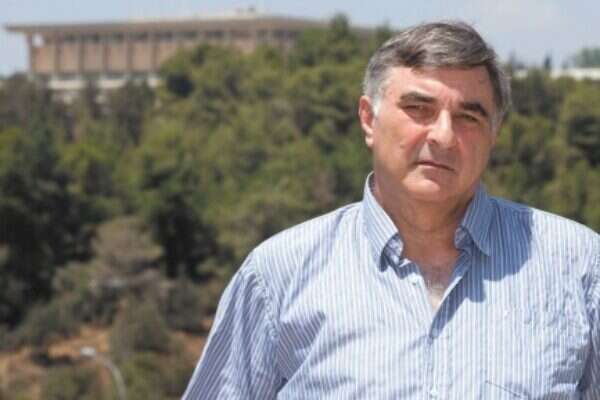
The spark that ignited the protest is like the sparks that ignited the town squares in Cairo and Athens. Professor Avraham Diskin At the entrance to the Mamilla pedestrian mall, near King David Street, stands a large statue of King Zedekiah, the last king of the Kingdom of Judah during the First Temple period. In chains, blinded, his hands spread wide in a gesture of despair and bewilderment, the king has been returned 2,600 years after his exile and placed facing the walls of the city that he once ruled. Elsewhere, in a foundry in Jerusalem, a statue of Herzl is now ready. It will be placed on the terrace of the building in Jerusalem where he stayed when he came to meet Kaiser Wilhelm II, the emperor of Germany. Both of these statues are the work of Professor Avraham Diskin, a world-renowned expert in political studies. One gets the impression that the connection between past and present, between the Bible and Zionism and between Judaism and democracy comes naturally to Diskin, who is in the process of publishing a new textbook about the fundamentals of civics, "Regime and Politics in Israel." The book will help pupils prepare for their matriculation examinations. This is the first time in many years that a renowned expert of his stature has written a textbook for the matriculation examinations. According to Diskin, the social protests currently flooding Israeli cities, for better or worse, are an excellent lesson for all of us. We met on the Ninth of Av, which is a day of mourning and remembrance on the Jewish calendar, in order to talk about destruction, protest and democracy. Q:
A:
Nevertheless, the people who are in the greatest distress Arabs and the Haredim are not really participating in the protests. In my building, most of the residents live in two apartments that also serve as a hostel for rehabilitating homeless people. It is good to live there. I am constantly reminded that I could have been where they are. You get addicted to alcohol or drugs, or you lose your job and get divorced. Anyone could be in that situation. People like that aren't at the protests.
Right now, if the protesters are right when they say that theyre both right-wing and left-wing, religious and secular, Arabs, poor people and members of the middle class, they cant say These are the things that need to be fixed in a unified way because each group has its own positions, and these positions contradict each other.
Q:
A:
In the short term, it appears that the protests have a political influence, but paradoxically, what is happening now actually serves the current government. Were not seeing a significant transition from a right-wing bloc to a left-wing one. One the other hand, the Labor Party and Meretz are growing stronger at Kadima's expense. In addition, the weak identification with the protests, on the part of Kadima leadership, could push some of undecided voters, currently choosing between Likud and Kadima, entirely toward the right-wing bloc.
Q.
A:
The response to the protests is also different. Our governments response is extremely soft, and rightly so. It recognizes that some of the claims are just, and refrains from unnecessary and violent conflict. In this context, one need only mention what has been happening in London over the past week.
Unwise Criticism
Q:
A:
Those who live from hand to mouth and concentrate on surviving dont go to demonstrations. But those who have failed in the struggle to survive are liable to engage in more extreme activities. The Arabs and the Haredim have a great deal in common, and their identification with the young people on Rothschild Boulevard is very much in doubt.
Q:
A:
The radical left-wing are among the people brainstorming solutions, and the chance that they will accomplish their goals is nil.
I heard repeated announcements, even from officials from the Meretz party, about supporting the free market while preserving the welfare state. Incidentally, not even neo-liberals deny the principles of the welfare state. We need only mention Jabotinskys famous "five mems" (five Hebrew words that start with that Hebrew letter:
Besides what I said, I am certain that the wave of protest will bring about policy change in many fields such as encouraging construction, removing obstacles in the spirit of the National Housing Committees Law and increasing the supply of residential apartments. The citizens will not benefit from everything right away, but the government will be rewarded or punished in the voting booth by how much those changes have effected the population by the end of its term.
Q:
A:
Education for Democracy
Q:
A:
I decided to follow in the footsteps of Abraham Lincoln, who, in the Gettysburg Address, expressed his desire that "a government of the people, by the people, for the people, shall not perish from the earth." To me, this statement reflects the three major elements of democracy. In democracy, the people are sovereign. Representative government is instituted by the people, and one of the government's purposes is to preserve the rights of individuals. The principle of sovereignty of the people, however, is problematic. Even completely nondemocratic regimes can declare that the people are sovereign. It is not entirely possible to hold free and fair reflections reflecting the will of the people.
In 1972, the Jewish-American economist, Kenneth J. Arrow, won the Nobel Prize for proving that every method of elections violates, of necessity, basic conditions of democracy. The question of rights is every bit as problematic. It is obvious that no right is absolute. For example, almost every law restricts the right to liberty. One of the most famous contradictions is between the right to liberty and the right to equality.
Q:
A:
In a practical sense, in order to analyze the advantages and disadvantages of electoral methods, you need profound knowledge of at least three fields: social choice, familiarity with the various electoral methods that exist across the globe and a familiarity with the many studies about the relationship between elections and their social consequences. Repeating the imaginary advantages and disadvantages of a mere two methods for elections does not enhance the comprehension or analytical ability of Israeli students, who are very intelligent.
Q:
A:
Q:
A:
Q:
A:
Q:
A:
For example, it is taught that there is a continuum with the nation-state at one end and the state of all its citizens at the other. But many of the world's most admired democracies are nation-states. Many countries have national immigration laws that mention our Law of Return. So in truth there is no conflict.
Q:
A:
The state of Israel was established as the home of the Jewish people. I am in favor of recognizing the rights of the Palestinians in their own states Jordan, Gaza and the Palestinian Authority. Here in Israel, they should be granted rights as individuals, but not on the national level.
This law sets forth the state of Israels raison dêtre. Otherwise, what are we doing here? Incidentally, regarding Netanyahus demand that the Palestinians recognize Israel as a Jewish state, there were those who said, "Why do we need recognition from the Palestinians? We recognize ourselves as a Jewish state." So we wrote it into a Basic Law. Anyone who is against that law opposes the State of Israels reason for existing.