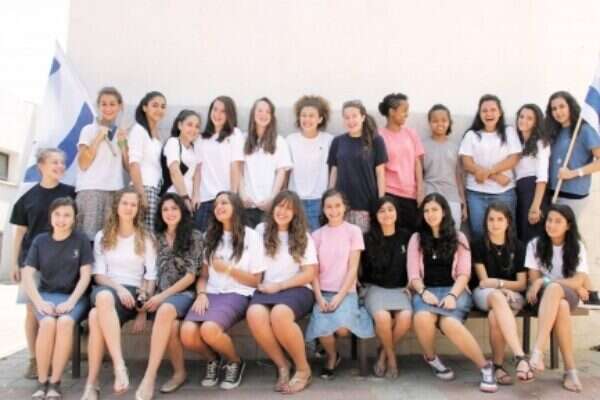
Good friends Liora and Naomi chit-chat like 18-year-olds. They discuss in minute detail the math matriculation test, what will they wear tomorrow, the military draft, their parents, and the end-of-school party. Their idiomatic teenage Hebrew is accompanied by their obvious accents; Liora's is Persian, Naomi's is French. At a nearby sun-drenched desk Liora's sister sits with her good friend. Whoever passes them will be bewildered by the Brazilian accent of one, and the Persian accent of the other. Another group of girls is noisily chatting at the high school entrance. They speak in "Hebrish" (Americanized Hebrew), with a pinch of Spanish. Near the biology lab, three girls chat in Italian accented Hebrew slang. One of them has a distinct Dutch cadence to her speech. A truly Israeli picture ... This Tower of Babel can be found at the Amit Renanim High School, a religious school for girls in Raanana. It's not a dedicated school for immigrants, an absorption center, or Ulpan (institution for Hebrew language learning). It is a regular high school with 650 female students, 450 of whom were born in Israel, and the rest of whom came here from all over the world. We found no less than 200 immigrants from 22 countries, including Hong Kong, Colombia, Switzerland, Australia, Iran, Holland, Poland, Great Britain, and Costa Rica, to name a few. Throw a dart at a globe, and you will find a student from there at Renanim. There is even a girl from the island of Guadeloupe in the Caribbean. The attractions of Raanana to immigrants from rich countries, has brought together this unusual melting pot of representatives from all over the world in a single high school. This is a place where at the water cooler, during recess, one can listen to words spoken in eight different languages. Only the universal school bell rises above the languages and dialects, unifying this small global village, as students hurry off to a Bible class. City suitable for immigrants In the next school year, Guy Nataf (45) will make his way to Israel from New Jersey. I met him by the faculty room where he arrived to register his daughter for 9th grade. He is a returning Israeli citizen whose daughters were born abroad. When asked "Why return", he says there are a few reasons, with the main, and "most honest" one being to get a front row seat for the return of the Messiah. "The time of the redemption has come, and I am returning to Israel to be here when it actually happens", he says, as he signs the registration forms. Leah Etinger, the school's immigrant coordinator asks for his daughter's e-mail address so that girls in her class can begin contacting her. "We have a reputation of taking care of new female immigrants", says Etinger, shrugging her shoulders humbly. "We have heard of families who choose to immigrate to Raanana, even though their relatives live in other cities, because we have a high school here that accepts and embraces new immigrants. Generally, this city is suitable for immigrants; we have several synagogues for English speakers". And how are the immigrants received? There is a full-time immigrant coordinator, special matriculation exams, translations of material to different languages, and grade-wide activities for both new and veteran immigrants. Renanim is perhaps a microcosm of Israeli society, as Israel specializes in immigrant absorption. On the other hand, unlike Israel, which has absorbed more than one million immigrants from the former Soviet Union, not a single immigrant from the vast Russian-speaking regions can be found at Renanim. In addition, only three Ethiopians attend the school. Most students hail from industrialized wealthy Western countries, immigrants who come to Israel in quiet waves. They belong to families that prepare themselves well before moving to Israel. Most of them buy or rent apartments here before they arrive, and don't enter absorption centers. Many of them already speak Hebrew, which they learned in their native countries. For the schools, immigrant absorption is a trying task, even when the immigrants arrive from rich countries. "But", I prod Etinger, "you are not like schools in the city of Lod, where a third of the students were born in Ethiopia". She agrees quietly that perhaps she has it easy, but that there are some parallels. In Renanim, "The bridge builder," a title the Education Ministry uses for an Amharic-speaking teacher responsible for relations with the parents of Ethiopian students, has taken on a new meaning, "French-speaking bridge builder", a title previously unknown to the Education Ministry. One teacher points out the differences in mentality between Israelis and immigrants. For instance, there is the difficult issue of setting bounadries in terms of modesty. "Immigrants from the U.S.A. and France were raised in a different culture. There is a mental gap between what is and is not considered modest. When it comes to modesty, religious communities abroad have different standards than people do here in Israel. In addition, girls raised abroad attended educational institutions that set clear-cut strict rules, whereas here they feel freer and find it harder to set their own limits". From Esfahan to Raanana With backpacks displaying 22 flags, the school tries to make students' touchdown here as pleasant as possible, whether that means a project in which 12th grade girls adopt girls in lower grades, or Torah classes given by rabbis in English, French, or Spanish. Some classes consist only of new immigrants, while others are mixed with both recent and veteran immigrants. To help integrate the students, the staff tries to develop and carry out social activities for all. But despite these idealistic dreams, reality always has the last say, and the students generally gravitate to their own groups, even when they are in diverse classrooms. Bridges are built between new immigrants, alliances forged, but during recesses they stick to their own. In six months pretty Liora will be inducted into the IDF. She has perfect Hebrew. Only three months ago, she lived in Esfahan. Really, Esfahan-, I ask. She nods, making sure I write that it is a city in Persia, not Iran. Her best friend is Naomi, who immigrated to Israel from France two years ago. Liora's father passed away tragically when she was ten, and a few years later her mother gathered her five children and immigrated to Israel. They made their way through a third country, leaving behind a large estate and many belongings, and went straight to a two-room apartment in an absorption center in Raanana. "I remember the large house we had in Persia" she relates. "I had a big room all to myself, while I now live in a single room with four other siblings. But I don't mind. I wouldn't even mind if I lived in a carton box on the street. The main thing is that I live in Israel". I don't hide my surprise concerning the last sentence. "You were born here", Liora tries to explain. "You will never understand it. I and all the other immigrants who weren't born here are filled with appreciation for every moment we are home. There is a spark in every Jew of the love of Israel. I was raised hearing about Israel all the time. I arrived here at the age of 15 and I thank God for that each day." During Liora's first few days in Israel, three years ago, the country was very interested in the new immigrants from Iran. Immediately after publication of several articles in the press, the property they left behind was confiscated and appropriated by the government. Due to the danger of retaliation upon the families they left behind, Liora uses her first name only for this article. In Renanim she studied chemistry and Arabic, 5 units each. "The Arabic I learned here, is not similar at all to the Persian language I grew up with. It was difficult," she says. "Even for the other matriculations no one was available to translate for me to Persian. I did all the tests in Hebrew, without the usual help given to new immigrants. Thank God I passed them all." In December, she will enter the IDF, the Intelligence Corps, of course. Matriculation, the hard way Is Liora a success story? "With every student arriving and taking the matriculation exams in Hebrew, and there are quite a few of them, there is a success", says Etinger. She gives some examples, such as a student in tenth grade who finished her Bible study class in Hebrew with a grade of 100. There is also the case of a girl who took the national exam on the book of Leviticus and passed with distinction. Arian Elimelech, the French bridge builder, tells of a girl who arrived in Israel at the beginning of the year, and ten months later, at the end of the year, took the full regular matriculation exams, turning down the leniency afforded to new immigrants. Elimelech goes through the list of students, "This is not exactly the Tower of Babel, but it almost is", she laughs while flipping through the list. The high school principal, Michal Jacob, also an immigrant, came from the USA. Her husband was also born there. "My heart is with them, because I too went through the process. It's important that we help them". The Amit school network was established 85 years ago, and spans dozens of institutions catering to the religious-Zionist crowd. Director Amnon Eldar says that one of the first such institutions was Kefar Batya in Raanana, which accepted refugees who had survived the Holocaust. "Zionism and immigrant integration runs deep, even after 65 years of Kefar Batya," he says. "Today, every time I meet a large group of immigrants, I feel some closure. The entire staff deserves the tip of the hat, as does the City of Raanana which has been a magnate for immigrants and invests in their integration. The girls line up for photo shooting, giggling in eight languages. An entire choir. They are beautiful, and I look at them seeing our state's reflection: a small country, an alphabet soup of languages, and the variety of ethnic groups and colors. Then they are done taking pictures and one of the security guards stands next to me. "All agree that Renanim is a true melting pot," says the guard. "The ingathering of the exiles is what makes our nation so great".
A lesson in geography
The Amit Renanim high school in Raanana is the closest version to the Tower of Babel. 200 new female immigrants from 22 countries fill its classrooms. Young girls from Iran, Poland, Columbia, and even Guadeloupe live in harmony.
Load more...