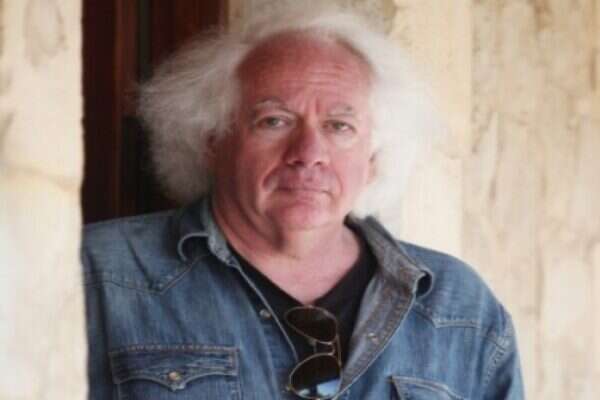
Anyone who meets Leon Wieseltier is guaranteed to be ill at ease. I met him at a conference of the Global Forum of the National Library of Israel, which he co-chairs. Wieseltier has also been the literary editor of the prestigious publication The New Republic for over 30 years, and is one of the most prominent thinkers in the U.S. today. He studied at a yeshiva in Brooklyn as a young man, and then attended Columbia University and later Harvard and Oxford universities. He won the National Jewish Book Award for his book, "Kaddish." He made a guest appearance on the legendary television series "The Sopranos." Generally speaking, in every debate on American Jewry, sooner or later his name will be mentioned. Very few Jewish intellectuals who feel at home talking about the origins and ancient characters of Jewish civilization are then able to land in Israel, in the here and now, and talk about the sweaty Israeli political reality with as much ease. Wieseltier, 64, is fluent in Shakespearean English, but also speaks excellent Hebrew. During our conversation, which at times became a heated debate, we referred to important works and texts from generations of Jewish literature, the Bible, the Mishnah, the Talmud, and the commentators of the Middle Ages, as well as modern Hebrew literature. It was a conversation with a learned student. * * * I choose to begin the conversation with the negative opinion held by many cultural figures of our day, not just in Israel but also among American Jews, in regard to Israel and the Jewish people. I ask him whether this stance reminds him of Julien Benda's "La Trahison des Clercs" ("The Treason of the Intellectuals") from 1927. They only have negative things to say, I tell him. We have had enough. Don't the Jews need some comforting and encouragement- "The truth is that not only do we need encouragement, there is a factual foundation for encouragement," Wieseltier says. "I wouldn't say that it is the treason of the intellectuals; the problem is that most Jewish Americans don't even know this place. All they know about Israel is the myth of conflict. They don't speak Hebrew. They don't know the Israeli culture. They have no idea. They know Yehuda Amichai, A.B. Yehoshua, David Grossman, whatever is translated into English, but they are illiterate. The problem is that in order to know this land, you need to be familiar with the Bible and speak Hebrew, and know a little Jewish history, otherwise you are a tourist in your own country." Q. What do you think about the apocalyptic discourse that has developed here and in the U.S. in regard to Israel's future- "I don't see the situation in Israel as apocalyptic. On the other hand, I respect the concerns. There is good reason for concern. If we are talking about peace or reconciliation with our neighbors, there isn't much basis for hope at this time, on either side. I blame both sides." Why do you blame us- "In the past, I did not agree with the Left's assertion that the biggest obstacle standing in the way of peace was the settlements. Today, I think that the settlements are insane because they poison our relationship with the population that Israel has no choice but to live with." Putting "poisoned" relationships aside, why do you assume that the other population is actually interested in peace- "It is true that they are currently not interested in peace. But they are not going anywhere." To say that the settlements are the problem -- you have an entire region that is falling to pieces, and the only Arab oasis of peace is the Palestinians. We are protecting them, with the Israel Defense Forces all around them. The IDF is there because of the settlements. If there weren't settlements there, we would have an Islamic caliphate in the Samarian hills right now posing an enormous threat to us. If there were no Jewish communities there, the IDF would not be there either. "So they can live in the Galilee. This is the State of Israel, they have a right to be there [in the settlements], but I also have the right to jump off the roof -- it would not be intelligent for me to jump off the roof." I don't understand you. Why not be there- "The state was established in 1948, but now the period of establishment and creation is over. Now we are in a period of protecting the state, developing ourselves culturally and economically, and making this a great place. 1948 was not just an important milestone on the way to realizing some maximalist vision dreamed up by Zeev Jabotinsky or Rabbi Abraham Isaac Kook or the Biblical Abraham. Borders are important to me only in terms of security, not in terms of ideology." And what about Jerusalem- "When it comes to Jerusalem I am definitely a hawk." But everyone agrees that there is no solution to the conflict without Jerusalem. Jerusalem is viewed as a settlement. "First of all, the mere mention of Jerusalem destroys any chance for dialogue. If the Arabs had wanted to hold on to half of Jerusalem, they shouldn't have attacked in 1967. On the other hand, we need to find some kind of solution. I believe that if there is ever an opening, things can be worked out." Do you want to see the Palestinian flag waving over the Temple Mount? Could you handle that, emotionally- "It depends. I will be honest with you: If it means the difference between peace and the absence of peace, I can live with it. This country survived for 19 years without the Temple Mount, and it never launched a single attack with the aim of claiming the Temple Mount. For 19 years there was no Hebron and no Cave of the Patriarchs." For 19 years we yearned. But once it is already in our hands, it makes a difference. There is a concept in the Talmud -- "Onnes rahmana patrei" ("The Merciful One absolves anyone who acts under duress"). When you are forced to do something and you don't have a choice, the Torah exempts you from punishment. But once we already have it, and we just hand it over to them, it is historically irresponsible. "It depends. I think that the guiding principle is security. I look at the peace problem as a security problem. That is what most worries me. Faith, culture and nationalism are a second priority for me, and I am a Zionist. I have been an enthusiastic Zionist all my life." Isn't Zionism about returning home to Zion- "No. Zionism is the conclusion drawn from the history of the Jews -- that the Jews are a people and as a people they have rights. They have a country in this place because this is their land, and they don't have another place of their own anywhere in the world. The Zionist identity can only be realized here, in this place, and only by way of sovereignty, like any other nation, a state with a Jewish majority. Otherwise, the practical implications of Zionism become irrelevant. Jewish sovereignty in Israel, but not over every inch of the land. "The Land of Israel is a kind of perpetual metaphysical temptation for any Jew who is in touch with his Jewish identity. When I visit Beit El or Ofra, it is impossible for me not to think about the fact that Jacob dreamed his dream there. I get chills and my spirit is always lifted, because it is the same spot where our forefathers walked, and I was raised on the Rashi commentary (about this place). But then, the intellectual process begins: What are the implications of my experience? It is true that if a Jew visits the Temple Mount and isn't moved, then he is a dead Jew. His soul is dead. But that is not the end of the story, because there are security considerations as well. I still have my love for the Land of Israel, and the feelings I experience when I visit these places, and I am pretty familiar with them. I don't reject them. I am uplifted by them, always. A substantial portion of the people who are ready to relinquish these places do not share your cultural experience. "Fine. I have already decided that I don't base my entire outlook on the Left, neither here or in the U.S. I refuse to give the Left that power, I have had it. I have other things to think about. I grew up as a religious Jew. As a Jew, I live in Hebrew. As a goy, I live in English. But that is not the end of the story. I don't trust feelings or subjectivity as a basis not only for politics but for shaping a worldview. When I was studying Kabbalah, I also learned about Christian mystics whose mystical experiences were much more intense than those experienced by our mystics. I would joke that I have 'mystic envy' because nothing like that ever happened to me. But one day I thought about it and I realized that I don't have mystic envy. If it [a mystical revelation] were to happen to me, I would not have believed it. That is why I always say that it was an enormous gift that when Moses asked God to reveal himself, God refused. Otherwise we would be left with an image of a man, on a cloudy day, with some wind and some dirt in the air, wondering what he saw. I don't trust that. Making Judaism portable Q. Let's talk about an issue that fascinates me. George Steiner once talked about the fact that we Jews are about the book, that text is our homeland, and that our return to the physical homeland hurts us because we are now confronting mundane issues and dealing with immorality etc. It is not just Steiner; it is characteristic of the Christian separation between heaven and earth, between the spiritual and the physical. I want us to talk about that in reference to American Jewry. I am seeing a kind of liberal elite that is more loyal to U.S. President Barack Obama than they are to us. I feel that in a certain sense they have given up on the vision of combining heaven and earth. They have chosen heaven. Just the book. "I understand what you mean." Yirmiyahu Yovel talks about how the conversos in Spain and in Portugal relinquished their faith in order to integrate into society; the Jews of the West, starting in the 18th century -- and in a certain sense that includes American Jews -- relinquished their national identity in a similar effort to integrate into society. "Not anymore. On the one hand, American Jews' faith is founded on something. It is justified. America represents a revolution in the history of the Jewish people. Even though I know what the Jews in Germany said in the 1920s, such a thing won't happen in America. I believe that. It goes against the philosophical basis and the political structure of the country. America is a revolution -- something unprecedented in the Jewish experience in the Diaspora. American Jews live in America as a Diaspora that isn't exactly Jewish exile. It is something new, with a foundation that is not just theoretical." That's because you view what happened in Germany as a short process. What if you looked at Germany in the 1930s as the culmination of a 1,000-year process? "There is anti-Semitism in America, and there always will be, but it will never be seen as legitimate. When Martin Luther King Jr. started his civil rights campaign, he based it on the U.S. Constitution itself. He didn't have to look outside the system. The principles outlined in the Constitution justified his objection to the reality in America. In fact, it was internal criticism. That is something new. A presidential candidate will never be elected on the basis of an anti-Semitic platform. Anti-Semitism exists, but there is racism here too, and everywhere else in the world. You can't remove racism from the human heart; you can only delegitimize it. That is all that can be done -- raise the political costs. Raise the social costs. You can't go into a racist's mind and heart and fix them. So there is the American Jews' faith. The second thing is that in the Diaspora, we are still living with what Rabbi Yohanan ben Zakai did. His revolution." It is true that he asked for "Yavne and its sages," but he said Yavne, which means that he stayed in Israel. "What he did was to make Judaism portable. In other words, it was no longer the Temple or Jerusalem. If he hadn't taken Judaism out of the Temple, it would have died. The Romans would have finished off not only the city, but the entire civilization. That is how he understood it. That is why the Jewish civilization was created and developed in exile. On the basis of the Bible. But what is the Bible-" Also on the basis of the Mishnah. "The Mishnah is the only part that was not created in exile." What about the Jerusalem Talmud? Israeli poetry? Eleazar ben Killir and the rest- "But we go by the Babylonian Talmud. Fine. So the Jerusalem Talmud and Killir. But the entire Babylonian Talmud, and the Geonim and the Sephardi culture and the Ashkenazi culture and the eastern European culture, it was all created in exile." Because there were no Jews left here. "From the standpoint of Jewish civilization, it didn't matter if there were Jews in the Land of Israel. Classical Zionism's worst historical-philosophical mistake was to put the entire period in which our civilization was created in quotation marks. It is undeniable." I am familiar with that claim. But what is the historical basis for all the cultural development in exile? The basis was here, in Israel. "No. it is the Talmud. We are a Talmudic civilization. Half in Israel and half outside it." The Talmud is based on the Mishnah. "So there were 200 years in Jerusalem, Sepphoris and the Galilee, fine." Not just that. The debate style that appears in the Talmud started in Israel. I am not saying that you are wrong, I just want to say that there is more. Israel played a crucial role in the creation of the civilization. "Rashi, Abraham ibn Ezra, Yehuda Halevi, Nahmanides, the Vilna Gaon, Shaagas Aryeh, Hatam Sofer, Noda Biyhudah, Sefer Hasidim, all of them were not in Israel. No existential affiliation. They hoped and dreamed and believed, that is true ... " Their affiliation with Israel is the foundation that was created there. "No! Their foundation was their books. Part of the greatness of that civilization is that they did everything from their own inner resources. They didn't have a homeland." Let's go back to U.S. Jewry. "So in exile, in the Diaspora, there is always the book rather than a homeland, even though America is something new -- not exactly a homeland but also not exactly not a homeland. America's revolutionary historical status has to be acknowledged." Is it exclusive to the U.S.- "Maybe it exists in Canada, I don't know. But not in Europe. Any self-respecting Jew has to have nothing but contempt for Europe. Anyone who is currently disappointed with Europe doesn't understand what Europe is. We shouldn't be disappointed in Europe because we shouldn't expect anything from Europe when it comes to the Jews. And not just the Jews, also in their attitude toward Islam and the Muslims. On the question of 'the other,' Europe is a net loss." Is the U.S. not following in Europe's footsteps? It looks like the U.S. is slowly losing its precedence in the world. "I'm not so sure. Under Obama, there have been problems, and that is why I don't support him; he took us backward. He made America small. When America is small, it is like a science experiment. If you want to see how the world would look if America were small, look now." So why do American Jews still support him- "Not anymore. No one supports him. Real opinion polls. He always scores under 50 percent. He is finished. No one likes him anymore." Indifference is the end Q. We talked about exile and the book. "In exile, the book is all there is. The link to Israel and to the homeland is through the book. I have a serious problem with American Jews: It is not that they don't rely on the book, but that they don't rely on it enough. They are illiterate. Like I said, they don't speak Hebrew or Yiddish. They read Jewish books only in non-Jewish languages. The problem is not assimilation, but ignorance. I always say that heresy is fine, but indifference is the end! You can't argue with indifference. You complain that they rely too much on the book? I wish. If only. So where is the other part, of life, of the land -- not life in the ethnic or folkloric sense, but in the sense of living a sovereign Jewish life- "Jewish American support for Israel has always been complicated, in the negative sense of the word, from a psychological and cultural perspective. On the one hand, as Jews, we have a moral obligation to display solidarity toward every other Jew in the world. For me there is a word that is bigger than Israel or Zionism and that word is 'Jews.' We need to help our brothers in Russia, in Iran, and of course, in Israel. There is this universal Jewish solidarity. On the other hand, the Jewish identity of American Jews was shaped vicariously, through other Jews." How do you explain that- "It was an immigrant community. After the pogroms in eastern Europe from 1880 to 1920, the Jews came and brought the old country with them. Spiritually speaking, they weren't actually living in America, so they never developed a cultural identity. Then, their children's generation, the 'alrightnik' generation, assimilated and discovered America. Alrightnik- "That's what they were called. Alright with everybody. It was in the 1920s and 1930s. They could not be expected to develop a Jewish American identity. Then came the generation of the grandchildren. The Holocaust was during this generation, and the establishment of the State of Israel. There was finally some hope that America's Jews would create something Jewish out of their experience." Do you mean an original creation? An identity of their own- "Using their own resources, not something they got from their grandparents or from some rabbi who came from Frankfurt or from Warsaw. Something of their own. But no. They lived vicariously through what was happening in Europe, and of course through Ari Ben Canaan, of "Exodus," once the state was established. Throughout my childhood I could never decide whether I wanted to be Ari Ben Canaan or Dov Landau in the Irgun. My father was a Revisionist. "There are two sides to this question: On the one hand, we don't want Jewish American support for Israel to wane. On the other hand, I also want my Jewish identity to be founded on something real. In other words, I don't want the liberals to base their Jewish identity on the fact that we are oppressing the Palestinians, or the conservatives to base their Jewish identity on the fact that Israel is building homes in Ofra. Because they do neither -- they are not oppressing the Palestinians nor are they building in Ofra. You are doing, or not doing, those things. The problem is that the Jewish identity of American Jews is so thin -- it is Woody Allen, Philip Roth, Seinfeld and Larry David. What is that? How can you raise children on Seinfeld-" Your viewpoint has to do with the fact that you had a religious upbringing. Your upbringing was very scholarly. You know how to read a Gemara page -- most Jews don't. "That is true, but it doesn't exempt the Jewish community in America from raising their children. They need to educate them. I knew a very wise judge in Cambridge, Mass., who once told me: 'The only people who have freedom of thought in matters of religion as adults are people who were indoctrinated with religion as children.' He was right. You can't rebel against something you are not familiar with. I say that to call someone a heretic is something of value. "Yes! Because a heretic believes in something. I wish there were more heretics. The classic heretics knew their stuff. So on the one hand, they need to educate their children. On the other hand, American Jews are extremely talented people. They are capable of building a business over the course of a summer and earning millions of dollars in the winter. They can do whatever they want. They have the energy. If they don't do it in the Jewish context, it means they don't want to. After all, adults can learn a little Hebrew, but they are just not interested. They don't believe that they need it to be Jewish. Like I said, it is unprecedented." So what does it mean- "American Jewry will not disappear, but it will become an ethnic group, with an ethnic culture. They will forget the glory of what they once were. In America today -- under conditions of peace and security -- more Jewish traditions disappear than in all of the Jewish exile, when the Jews were poor and oppressed. It is a historical crime. They just don't care! "Of course they are proud of being Jewish, but I always say that Jewish pride is inversely proportional to Jewish knowledge. If you are knowledgeable, you tend to be a little quieter." What are American Jews so proud of? "In America, it is no longer necessary to hide or conceal any part of your identity. In the 1930s and 1940s it was a problem. But ever since the 1960s, when the entire American population was redefined, ethnically speaking, it was no longer necessary to erase anything. On the contrary, if you didn't have the old country, you weren't exactly American. Because every American comes from somewhere else. There's that hyphen: Jewish-American, Afro-American, Italian-American. If you don't have a hyphen, what kind of American are you? Not only is there no penalty for developing your own inner resources, it is encouraged." The impression that we get here in Israel is that the Jewish American Left is obsessive about our story, mainly our conflict with the Arabs, and therefore distances itself from us. "A substantial portion of the Jewish Left bases its identity on the Palestinians. That is the case, you are right. To their credit I will say, however, that they believe in justice, and there are moral elements to this standpoint that cannot be dismissed." We know that part. I am more interested in the first part -- your interesting observation. Why do they need to base their identity on the radical other- "Because they don't have other Jewish elements on which to base their identity. They are ignorant. Illiterate. Not religious. They robbed themselves of their own resources and origins. The biggest challenge is not this irritating Left. The biggest challenge is reminding the American Jewish community what Jewish culture and tradition are. Here in Israel, there are those who think that American Jews do nothing but read their texts. I wish that were true. The essence of the identity is losing its substance. The form of the identity is taking on an ethnic nature. I believe that the way to measure a person's Jewishness is by the standards of the Jewish tradition. But the question is always 'compared to what-' "I believe that I have to compare my Jewishness to the Jewish tradition that preceded me and that was handed down to me. Therefore, I don't measure my Jewishness against popular American culture, but rather against Jewish tradition. Because that tradition that made its way to me, despite the efforts to exterminate us in every generation, is a miracle. After everything that happened, we still have the books, and we have the freedom to read them quietly. It is my enormous historical responsibility to ensure that this is not forgotten. My son will inherit this tradition. What will he do with it? I don't know. He is a free man. But at least he will get it. It is imperative to educate children on Judaism, even if you don't believe it. It is about giving them a set of skills, not persuading them to believe. In order to be a Jew, you need a set of Jewish skills. If you don't have them, no one can help you, even if you are a proud Jew." The materialistic Jew's advantage Q: David Ben-Gurion once said that Jews come to Israel either out of desperation or because of some messianic vision. Where do you stand on the question of immigration to Israel- "When there is no pressure, and no vision, it becomes more complicated. Not only is there no Zionist vision; there is another element that complicates the debate: If you believe in democracy and freedom then every person has a right to live wherever they want. That is something very deep and it is important not to dismiss it. And of course there is always the tug of war between nationalism and democracy. On the one hand, the idea is that all Jews belong in Israel, and that is true. It is easy to understand. On the other hand, there is the idea that all Jews, if they are free, and we believe in freedom, can live wherever they wish." That is not what the dispute is about. "Exile is a pathological state in the absence of a homeland. But when there is a homeland, the question is whether the pathological status of exile really dissipates. There were Jews in Alexandria, and there were Jews in Babylon, and Babylon and Jerusalem is an ancient pairing. I don't have an answer for you. Every Jew who immigrates to Israel, and I have been contemplating this for years, I understand why they do it, and I respect it. They are actualizing their Jewish identity in a fundamental way, it is very deep and I admire it. However, there is the question of democracy and freedom and the thing about the universality of freedom of movement. Once you have a homeland, it may be that Jewish normalcy is Babylon and Jerusalem. Normalcy is not just Babylon, but the question is whether normalcy can be just Jerusalem." Only if U.S. Jews view themselves as Babylon. "I wish. That is why I say that what bothers me is not that they immigrate to Israel, but that they are not Babylon. That is the reason that there is no chance for a vision. A vision needs infrastructure: Jewish resources, Jewish tradition and Jewish texts; for Jews to live as Jews in a spiritual sense, not just in a political sense. Then you can argue about what kind of Jew you want to be, and whether you want to live in Israel or not. But in perpetual state of ignorance and indifference, there is not variety of Jewish identities. There is only politics and entertainment. There is Jerry Seinfeld and Joseph Lieberman. You can't raise children on that. You can't carry on a tradition like that. "In that sense, when a Jew immigrates to Israel and learns Hebrew, even if he doesn't study Judaism, he already has the potential to obtain the knowledge and the tradition. "For years I have been yelling at my Jewish brothers and sisters in the U.S. about their Jewish illiteracy, and they ask me, 'What about Israel-' I tell them that the most pagan, materialistic, pork-eating, bald-headed, t-shirt wearing, high-tech startup drug addict in Tel Aviv has more Jewish competence than all of them together, because of the language. I tell them we all have a keychain. On every one of our keychains we have a key that we never use. We don't even remember where it goes. But it is on our keychain. The most pagan, materialistic Israelis, they have it on their keychain, and the moment they want to enter their home, they can open the door. It is a permanent spiritual advantage." Even the biggest crime lord in Israel speaks the same language the cohen hagadol (the high priest of Israel) used to coax God to reveal himself to him. "Even if he doesn't know it, he has the skills. He may live his entire life and never take an interest. But the moment he feels a need, or feels curious, say his father died or he heard a Bialik poem sung by Arik Einstein -- he is interested, he is home, and he has a master key. The house has a lot of rooms, but only one door. And to get in you need a key. American Jews don't have that key. It is a tragedy." Do you feel lonely in the U.S.- There is no one to talk to. There are people I can talk Gemara with, but those people don't know Bialik or Avraham Ben-Yitzhak. And if someone, by chance, is somewhat familiar with Bialik, they don't know what a synagogue looks like. My tradition encompasses all of Jewish tradition: love songs, mundane poems and wine and questions and answers -- we inherited it all. Everything. And then we were able to choose whether it excites us or not. That is what excites the soul, and you end up chasing that."
'The problem is that Jewish Americans don't know Israel'
Jewish American thinker Leon Wieseltier tells Israel Hayom that he opposes settlements (they poison relations), that Obama "makes America small" (nobody likes him), and that Jewish Americans are ignorant (you can't raise Jewish children on Seinfeld).
Load more...