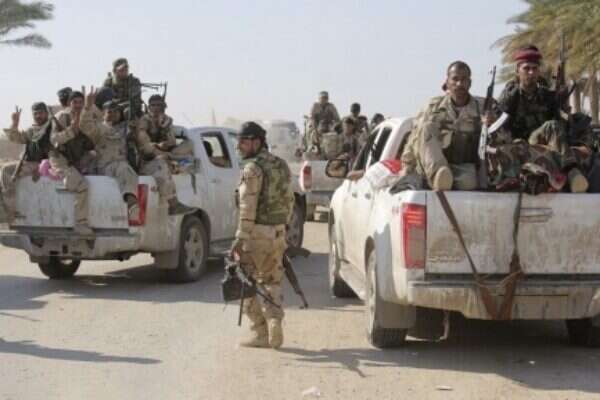
Iraqi government forces and Shiite militias seized control of the strategic town of Jurf al-Sakhar near Baghdad from Islamic State on Saturday and Kurdish fighters made gains in the north after heavy coalition airstrikes against the Sunni militants. Iraqi troops and their Shiite allies broke the grip of Islamic State in Jurf al-Sakhar after months of fighting against insurgents determined to march on the capital. "Our forces with the support of the volunteers are in total control over Jurf al-Sakhar now and the terrorists fled to the southwest areas of the town," a spokesman for security forces there said. A victory could allow Iraqi forces to prevent the Sunni insurgents -- positioned in several locations around Baghdad -- from edging closer to the capital, sever connections to their strongholds in western Anbar province and stop them infiltrating the mainly Shiite south. The security officials said the Sunni insurgents fled to the two nearby villages of al-Farisiya and Hay al-Askari and were still attacking with sniper fire and mortars. Government forces were preparing for a major overnight operation against them. In the latest fighting, 67 members of the Iraqi security forces and Shiite militias as well as 300 Islamic State fighters were killed, the officials said. It was not possible to get independent verification of the casualty tolls in the town 60 kilometers (40 miles) south of Baghdad. Speaking to state television in the town, Prime Minister Haider al-Abadi said Iraqis forced out by fighting would soon return to their homes. Islamic State swept through northern Iraq in the summer, facing little resistance from U.S.-trained government troops. The al-Qaida offshoot then declared a caliphate and threatened to reach Baghdad, rattling the Shiite-led government and intensifying sectarian bloodshed. On Saturday, a suicide bomber killed seven Shiite militiamen in a town just north of Baghdad, police and medical sources said. Islamic State controls large parts of the Sunni heartland in Iraq's western Anbar province, as well as swathes of Syria and wants to redraw the map of the Middle East. Sunni insurgents have been moving fighters, weapons and supplies from western Iraq through secret desert tunnels to Jurf al-Sakhar, Iraqi officials have said. Now it appears government forces may be able to disrupt that network. While Iraq's army and Shiite militias have resisted Islamic State efforts to move closer to Baghdad, Kurdish forces have also gained ground, recapturing territory in the north. The Kurds retook the town of Zumar and several nearby villages from early on Saturday after heavy coalition airstrikes against the insurgents, security sources said. If the Kurds manage to hold Zumar, that could enable them to disrupt Islamic State supply lines to nearby towns and cities. A Kurdish intelligence officer in Zumar said Kurdish peshmerga forces had advanced from five directions in the early morning and encountered fierce resistance. A spokesman for the peshmerga also said Zumar was now in Kurdish hands. Zumar was one of the first Kurdish-controlled towns to be overrun in August by Islamic State who went on to threaten the autonomous region's capital, Irbil, prompting airstrikes by the United States -- a campaign since joined by Britain and France. If the Kurds are able to keep Zumar, it would also make it easier for them to advance on Sinjar, where Islamic State are besieging members of Iraq's Yazidi minority on a mountain. Helped by the airstrikes, Kurds have regained ground but progress has been hampered by a lack of heavy weaponry and by homemade bombs and booby-traps laid by the militants. Gains have been easily lost in the war against Islamic State. The Kurds claimed victory in Zumar in September, only to withdraw from the town again after suffering heavy losses. One peshmerga fighter deployed in the area on Saturday said a sniper was still at large in a village adjacent to Zumar, and a car bomb had exploded when they approached a vehicle, killing seven peshmerga. In another village, Ayn al-Helwa, the peshmerga said 17 militants had been taken captive, all of them Sunni Turkmen. While U.S. airstrikes have had some impact on the insurgents, it is not clear whether they will be enough to secure a defeat in the long term in the major oil producer and in Syria. The United States and its allies conducted 22 airstrikes against Islamic State forces in Iraq on Friday and Saturday, the U.S. Central Command said. U.S. warplanes also destroyed an Islamic State artillery piece near Kobani in Syria, officials said Saturday. The town near Turkey's border appears in less danger of falling, but the threat remains, U.S. officials said on Thursday. The 22 strikes in Iraq included attacks on frequently targeted areas near the vital Mosul dam, the city of Fallujah and the northern city of Baiji, home of an oil refinery. On Friday, The Washington Post reported that Islamic State allegedly used chlorine gas on Iraqi security forces in Dhuluiya, 50 miles north of Baghdad. According to the report 11 Iraqi police officers were admitted to hospitals with the diagnosis of chlorine gas poisoning. Iraqi sources said it was third such attack in 2014. Islamic State militants reportedly used deadly chemical weapons fighting Shiite militants as well, causing 40 Shiite fighters to fall ill. So far there have not been any reported deaths from Islamic State chemical weapons, and details have remained scant. "These allegations are extremely serious and we are seeking additional information in order to be able to determine whether or not we can confirm it," U.S. Secretary of State John Kerry said on Friday.
Iraqi security forces, Kurds gain ground against Islamic State
In the latest fighting, 67 members of the Iraqi security forces and Shiite militias, as well as 300 Islamic State fighters, were killed, Iraqi officials say • Islamic State allegedly uses chemical weapons gas on Iraqi police.
Load more...